At Wildsuits, like many of you reading these lines, we have an unconditional love for the ocean. It is our playground, a place where we recharge, have fun, and find our balance, both literally and figuratively. In short, we owe a lot to it.
However, and unfortunately, it's no longer a surprise, our favorite natural space and the species that inhabit it are in danger. Human activity is to blame, as it has profoundly altered the oceanic ecosystem. The surf industry also bears some responsibility, and that's precisely why Wildsuits exists.
As water sports enthusiasts, we are the first witnesses of this catastrophic situation, but we can also become agents of change. It's not every day that we are offered a leading role, right?
So, we have gathered here the basic principles and behaviors to urgently adopt to become an eco-conscious surfer. With more and more people enjoying the ocean, it's an opportunity for us to unite our forces to protect the environment!
I pick up my trash

Fishing nets, cans, cigarette butts, plastic bags, bottles, and even wax packaging... Just a few meters on the beach is enough to realize that picking up our trash is not yet a habit for everyone. If no action is taken, there will be more plastic than fish in the oceans by 2050!
An action to implement starting today: when we go surfing, let's pick up at least three pieces of litter before leaving. It may seem little, but imagine if all 20 million surfers in the world did the same after each session! Having a trash bag in your car or pocket is always a good idea.
Large-scale cleanups are frequently organized by associations like the Dobby on the Map project. Participate whenever possible, or even organize your own cleanup. Feel free to contact us if you want to launch an ecological project locally, and Wildsuits will support you. le projet Dobby on the Map. On y participe dès que possible, quitte à en organiser soi-même. D’ailleurs, n’hésitez pas à nous contacter si vous souhaitez lancer un projet écologique localement et que Wildsuits vous accompagne.
A new threat has emerged on beaches since 2020: face masks. Before discarding one, even in the trash, cut the straps to avoid turning it into a deadly trap for seabirds.
I respect the environment

The golden rule: leave no trace of your passage. Of course, it starts with taking away your trash, but we won't insist on that. Oh, wait, yes, we will: pick up your toilet paper and food leftovers, which can disrupt the ecosystem (a banana peel is not natural on a beach in Brittany!).
To access the spot - even the most secret one - always use designated paths. Sand dunes, for example, form a particularly fragile environment, and their erosion threatens all the fauna and flora that inhabit them. Watch where you step to avoid trampling on species, and if you're lucky enough to encounter an animal, observe it from a distance, without trying to feed or touch it.
If you're camping for several days, respect the designated camping areas. Prohibited zones are there for a reason: they often protect fragile species or the local inhabitants who also deserve their peace and quiet. Nothing beats an evening by a campfire, but check local regulations and make sure it's completely extinguished before going to bed. In short, with a bit of common sense and respect, we can continue enjoying our favorite spots for a long time!
I choose an eco-friendly surfboard

Eco-friendly surfboard What is a surfboard made of? A foam core cast in polyurethane with resin, and fiberglass laminated on top. At first glance, nothing too harmful. However, these materials are extremely polluting and hazardous, both for the environment and the shaper who is exposed to fine particles and toxic emissions all day long. Not to mention that these materials often travel half the world before reaching their place of production and sale. A 3-kilogram surfboard could generate nearly 6 kilograms of non-recycled waste!
Some shapers are committed to offering high-performing surfboards while minimizing their impact on the environment. Some use bio-sourced epoxy and local and recyclable materials, such as flax fiber, which doesn't deplete the soil and requires less energy to produce. Others donate foam offcuts to companies that reuse them as raw materials. In recent years, there has been a return to the roots of surfing with the development of wooden surfboards crafted by hand. The most innovative surfboards are experimenting with cork, seaweed, or mycelium from mushrooms!
In addition to that, there are biodegradable resins, leash cords made from natural materials, bamboo or recycled plastic fins... It is now easier than ever to build an eco-friendly quiver. Also, consider looking into used surfboards and ensure you sell or donate your own gear to associations like Surfeurs Solidaires, for example. Finally, take care of your surfboard and resist impulsive purchases: extending the life of an object is the best way to reduce its environmental impact.
I choose an eco-friendly wetsuit

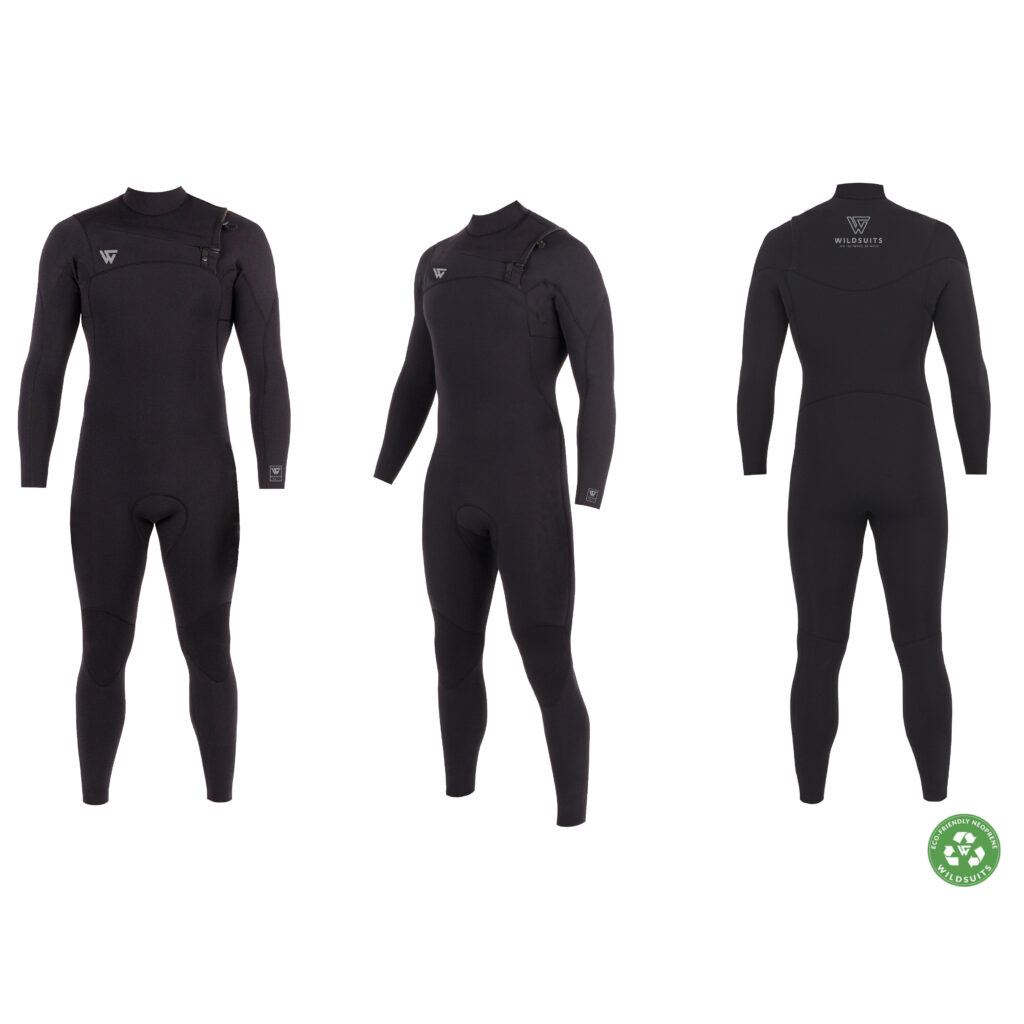
Eco-friendly surf wetsuit by Wildsuits The vast majority of wetsuits for water sports are primarily made of neoprene, a synthetic rubber derived from petroleum. Add to that glue made from toxic solvents, water and energy-intensive manufacturing processes, limited recycling... and you've got a real environmental bomb that you're wearing directly on your skin.
Fortunately, new materials that are equally (or even more) high-performing but much more environmentally friendly are being developed. At Wildsuits, we use Limestone, an eco-friendly neoprene, as well as Eco Carbon Black, a material made from recycled tires, eco-friendly glues, and linings made from polyester derived from recycled plastic bottles. We ensure that our production is ethical both environmentally and humanly, for eco-friendly, high-performing, and durable wetsuits, tested in the most extreme conditions, such as the giant waves of Nazaré! notre production soit éthique, tant sur le plan environnemental qu’humain, pour des combinaisons écologiques, mais aussi performantes et durables, testées dans les conditions les plus extrêmes, comme les vagues géantes de Nazaré !
Before acquiring a new wetsuit, do your research beforehand. Certifications and labels are a good way to navigate (ISO 9001 ensures product quality and uniformity through quality management, Fair Trade Certified confirms fair trade practices, Global Recycled Standard ensures the production of products from recycled materials...).
Also, take good care of your wetsuit and protect it from the sun to ensure its longevity and be an eco-conscious surfer. Finally, donate your old wetsuit, sell it, or recycle it to complete the loop of responsible consumption. Companies or artists are always happy to receive raw materials for their projects. On our side, we share our used neoprene with Flahica, who craft them into various objects, such as board protection covers.
I use eco-friendly surf wax

An essential companion for any good surf session, surf wax and its heavenly scent are also one of the most polluting elements in a surfer's kit. Made mostly of compounds derived from petroleum refining, paraffin being the main component, it ends up in the water and on the sand, with a direct impact on the oceanic ecosystem. Not to mention that direct contact with the skin can cause severe irritation due to the chemicals in the wax.
Good news: more and more brands like GreenFix or Terra Wax are turning to natural and biodegradable products, such as beeswax, and environmentally friendly manufacturing processes. It is now very easy to find these waxes in your favorite surf shop.
Most historical brands in the industry have also released their "green" models, but it's best to remain vigilant. As an eco-responsible surfer, don't hesitate to check the composition on the packaging. And to be 100% sure of the ingredients, roll up your sleeves and make your own surf wax! Numerous recipes can be found online, keeping you occupied during long confinement days...
I prefer non-toxic sunscreen

At the risk of sounding like your mother, we cannot stress enough the importance of using sunscreen. But while it protects the tip of our nose, it also becomes a massive weapon of destruction for the oceans and their inhabitants. The culprit is the chemical filters it contains, such as oxybenzone, ethylhexyl methoxycinnamate, benzophenone-3 and -4, or methylbenzylidene camphor. These names may sound scary, but their impact on the environment, especially on microorganisms, algae, and corals, disrupts the entire ocean ecosystem. Considering that we pour up to 6 billion kilograms of sunscreen into the sea every year...
The solution lies in eco-friendly sunscreens. Again, there are increasingly numerous alternatives. Check the labels, avoid the mentioned compounds, and prefer mineral UV filters and sticks that adhere well to the skin. Besides, conventional chemical sunscreens are only effective for 30 minutes after application. You might miss the best set of the day!
While we're at the beauty products aisle: if you shower at the surf spot, leave behind the shampoo and soap, which will probably end up in the sea. It may seem obvious, but it's curiously not uncommon to encounter such items, perhaps due to the illusion of eco-friendliness offered by some organic products. Like with the trash, the best thing to do is not to bring anything that isn't naturally present in the environment.
I monitor my travels

Sure, surfing all year round in 28°C water sounds like a dream. But is it reasonable to chase after "the endless summer" when we know that airplanes emit 285 grams of CO2 per kilometer? We don't mean to deprive ourselves forever of a surf trip to Bali, but to be an eco-responsible surfer, we should try to limit air travel whenever possible. If necessary, calculate the carbon emissions of your journey (numerous websites cater to this purpose) and offset them by making donations to environmental protection associations.
Europe, starting with our beautiful country, but also unexpected destinations like Germany, is filled with spots to discover. Even investing in a wetsuit for winter can allow us to enjoy surfing all year long. When traveling to these spots, prioritize public transportation, trains, and buses. On a daily basis, practice carpooling (or hitchhiking for the more adventurous) or invest in a bike rack. Besides being a perfect warm-up, cycling helps save money and avoid spending hours looking for parking in the summer. Better yet, walk there. Farewell to the worries of hiding car keys under a rock!
By the way, avoid leaving your engine running while chatting with friends or warming up the car. Nothing beats a beanie, warm socks, a thermos of coffee, and our little secret – bottles filled with warm water – to warm up frozen toes!
I am an eco-responsible surfer outside the ocean

All these good habits to adopt when surfing are also applicable in everyday life. Nearly 80% of the waste found in the sea comes from the land, and a cigarette butt thrown into the gutter will end up on the beach this summer. So the fight continues, on the waves as well as on the streets!
In general, avoid overconsumption. Only buy new items when necessary and, when possible, opt for products made in France that haven't been shipped by air. Minimize single-use packaging, invest in a reusable water bottle, refuse plastic straws, and choose eco-friendly, recyclable, and recycled materials (such as bamboo toothbrushes and wooden cutlery). When showering or rinsing your gear, be conscious of conserving potable water. There are numerous small daily habits that are more manageable than they seem. If each of us contributes, the future of the oceans and our next surf sessions will be secure!
Lastly, educate yourself, learn, and talk about it with others: ecology is everyone's business. If you have other ideas for enjoying the waves while preserving the environment, don't hesitate to contact us on Facebook, Instagram, or via email to discuss. Facebook, Instagram ou par email pour en discuter.
And remember: "On the wave, be wild. Out of the wave, behave!"