Introduction
Surfing takes place in a wide variety of environments, each offering waves with distinct shapes, power, and consistency. Understanding these differences helps you pick the perfect spot based on your skill level, preferences, and weather conditions. Mastering these types of waves marks the beginning of learning in all aquatic board sports.
In this article, we’ll explore the different types of surf spots around the world, illustrating each one with iconic examples. Our presentation will revolve around five categories: beach breaks, reef breaks, point breaks, river breaks, and innovations.
The goal is that after reading this article, you'll be able to choose the perfect spot to ride. Each type presents unique challenges and features, catering to different skill levels and styles.
Les Beach Breaks
Beach breaks are spots where waves break over sandy bottoms, continuously shaped by currents, tides, and swell. These sandbars determine where and how waves form, peel, and break. The result? An ever-changing underwater landscape, where a great morning spot might disappear by the afternoon.
Ideal for Beginners… In Theory
With their gentle slope and soft bottom, beach breaks are often recommended for beginners. Fewer coral or rock hazards mean fewer risks of injury when falling… however, reaching the lineup (the offshore zone where surfers wait for waves) can be more complicated than expected.
Beneath their welcoming appearance, these spots hide a few traps.
Pros & Cons
✅ Scattered crowds: No need to fight for a wave — peaks (where the wave breaks) are multiple and ever-moving.
✅ Easy access: From the beach (no need for boats or long treks).
✅ Wave variety: Shifting sandbars create diverse waves (hollow, soft, barreling), suited for all levels and styles.
⚠️ Difficult to read: Sandbars move constantly, and what worked at low tide might become “unrideable” an hour later.
⚠️ Energy-draining paddle outs: Reaching the outside often means battling through breaking waves — a real endurance test (especially if your board isn’t ideal for duck diving).
⚠️ Tricky currents: Rip currents pulling you out and strong lateral drifts can be surprising. A tip: fix a landmark on the beach to avoid drifting without realizing it.
Not Just Small, Soft Waves!
While beach breaks often produce short, soft waves, some turn into beasts under strong swell. And when sand meets rock, the spot can take on characteristics of a reef break — blurring the lines. (For more on swell and its impact on conditions, check out our article on surfing weather: [Surf Forecasting: Understanding Conditions for the Perfect Session]). [Weather and Surf: Understanding the Conditions for a Perfect Session].
Beware the Shore Break Trap
Don’t confuse a beach break with a shore break (where waves crash violently right on the sand with little water depth). As spectacular as they look, shore breaks are notorious for their punishing wipeouts and frequent injuries.

Conclusion: A Spot Not to Underestimate
The beach break is the ultimate democratic spot, but not always as gentle as it seems. Moral of the story? Always gather some intel before jumping in (the ocean loves its surprises).
Examples of Beach Breaks:
- Les Dunes 1 and 2 (Vendée, France): These multipoint beach breaks always offer something to ride. They work at all tides depending on sandbar formations and suit all skill levels (from beginners to experts).
- La Gravière (Hossegor, France): A legendary beach break where deep sandbars shape powerful, hollow barrels, reserved for experienced surfers looking for authentic tubes. Best at low tide with a west swell.
- Taghazout (Morocco): A mythical surf village with several spots for all levels. From consistent point breaks like Anchor Point to mellow beach breaks, the area offers diverse waves in a sunny setting year-round. Best time to visit: October to April.


Reef Breaks
Unlike beach breaks with their “welcoming” sand, reef breaks sit over coral or rocky bottoms. This creates more structured waves but also demands more caution. A poorly calculated fall can end badly, especially if the spot is shallow. Despite this, not all reef breaks are reserved for pros — some with deeper reefs offer smooth, manageable waves that allow surfers to progress safely.
A Diversity of Waves
Depending on the reef’s shape, waves can vary drastically:
- Steep reef = Hollow, fast waves, ideal for experienced surfers.
- Gentle slope = Easier, friendlier waves, suitable even for beginners with some experience.
This variety is what makes reef breaks so appealing: every spot has its own personality, and there’s something for every surfer.
Pros & Cons
✅ Wave quality: Hard bottoms create well-defined, often hollow and consistent waves.
✅ Easier access: Channels (areas without breaking waves) often allow for an easier paddle out to the peak.
⚠️ Caution with wipeouts: A shallow reef can be treacherous after a bad move. Always gather information before paddling out...
⚠️ One spot, one peak: Since the waves always break in the same place, the take-off zone can get crowded.
Reef breaks are fascinating spots where nature shapes waves with rare precision. With some preparation and the right choice of location, they can be a great option for all surfers — not just the most experienced ones.

Some Famous Examples
- Uluwatu (Bali, Indonesia): Bali’s legendary reef break, famous for its long, perfectly organized waves that peel for over 200 meters. It requires good tide reading skills. Best season: April to October.
- Guéthary (Basque Country, France): A challenging yet rewarding reef break, where powerful waves wrap over a rocky bottom. It requires a moderate swell and a rising tide. A technical spot that rewards precision — one of the few true reef breaks on mainland France.
- Pipeline (North Shore, Hawaii): The Holy Grail of world surfing. This shallow reef break produces the most photogenic (and dangerous) barrels on the planet. Strictly for absolute experts — a wipeout here can be catastrophic. It works best with a NW swell in winter (November to February). The soul of high-performance surfing.


Point Breaks
The Magic of a Wave That (Almost) Never Ends
Imagine a swell that doesn’t break chaotically, but instead wraps gracefully around a rocky headland or point of land. The result? A long, clean wave that peels for hundreds of meters, offering endless lines to ride. That’s the promise of a point break — the kind of spot where you can finally let loose without being cut off by a premature closeout.
A Flexible Seafloor
Unlike reef breaks, point breaks can form over:
- Rocks
- Sand (some are hybrid sand/rock point breaks)
- Coral (less common, but possible)
No matter the composition, what truly matters is that geographical point guiding the swell — that’s where the magic happens.
Pros & Cons
✅ ✅ Long rides: Get ready for the leg burn—some point breaks offer rides lasting over a minute!
✅ Predictable lines: Easier to read and position yourself on the take-off.
✅ Ideal for progression: You can link multiple maneuvers during a single ride.
⚠️ Crowded lineups: Quality waves attract crowds—drop-ins and tight take-off zones are common.
⚠️ Hard bottoms: Often rocky—falling wrong can hurt.
Localism: Legendary spots often come with intense local protection—respect is mandatory.
The Stars of Point Breaks
- Jeffreys Bay (Eastern Cape, South Africa): The ultimate right-hand point break, offering an 800-meter ride with a variety of sections — from fast barrels to perfect walls. It works year-round (best from June to August). Suitable for all levels depending on the section, but it can get very crowded. A paradise for flow surfing.
- Mundaka (Basque Country, Spain): Europe’s most technical left, forming only with a precise combination of a SW swell and high tide. A hollow, powerful wave breaking over rock, reserved for experts. A rare and fickle spot — when it’s on, the entire European pro scene shows up. Season: September to April.
- Chicama (Trujillo, Peru): The longest point break in the world (2km+ in optimal conditions). A perfect, endless right-hander, ideal for longboarding and cruising style. It mainly works from April to October. Shallow but relatively safe — the perfect spot for surfers chasing endless rides.


River Breaks
When Rivers Create Waves
Who said the ocean has a monopoly on surfing? River breaks bend the rules by offering waves... in freshwater! Here's what’s on the menu:
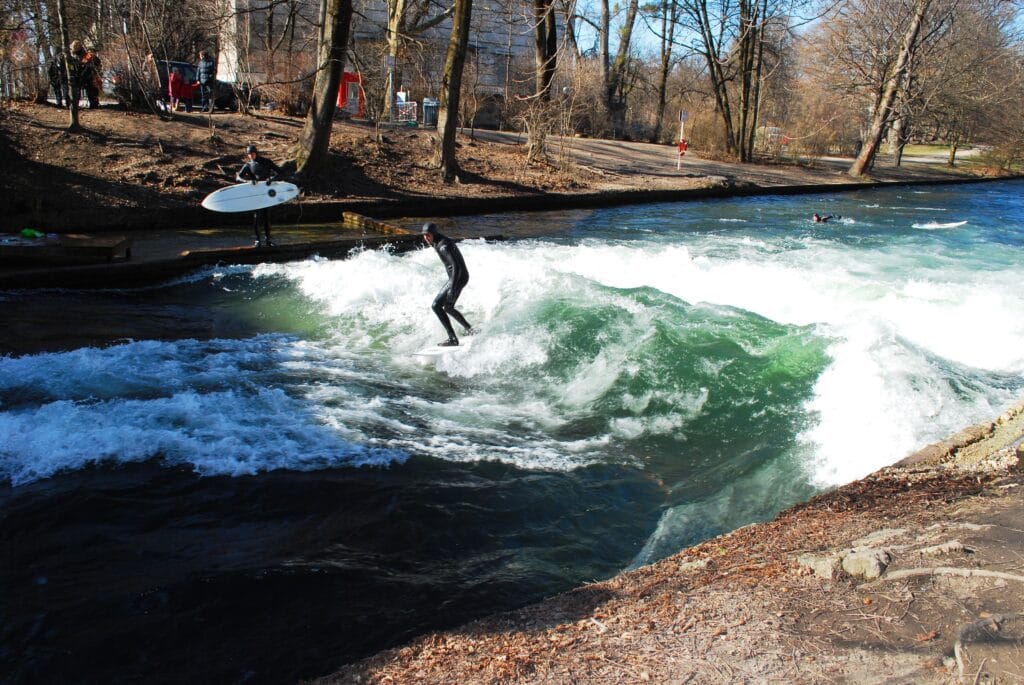
- Stationary Waves: Shaped by the river current, like in Munich (Germany), where surfers ride an eternal wave right in the heart of the city.
- Tidal Bores: These tidal waves travel upriver (like on the Garonne in France), creating unique rides — but only a few days a year.
The bonus: No exhausting paddling needed — the current does the work for you. The challenge: Mastering a very different kind of glide compared to the ocean, with shorter, more technical sections.
To learn more about River Breaks, check out our article on surfing in Germany[Where to Surf in Germany].].
The Rebels of Modern Surfing
The quest for the perfect wave has led surfers to ever more unusual spots:
✅ Artificial Pools (Wavegarden, Surf Ranch):
Perfect — and programmable — waves. No more waiting for the swell; here, you surf on demand.
Perfect for training.
✅ Icy Waters (Norway, Iceland):
A 6mm wetsuit is mandatory, the landscapes are breathtaking, and it redefines hardcore surfing. Heads-up: you’ll probably surf alone... but 5°C (41°F) water quickly reminds you that nothing comes easy.
✅ Volcanoes and Lakes (like in Nicaragua):
Surf with a view of a smoking crater — because epic surf deserves an epic backdrop.
River breaks, artificial waves, polar spots — surfing knows no limits anymore. These alternatives prove that the spirit of surfing is, above all, a story of adaptation... and a touch of madness.

Your Next Wave Is Waiting
From dynamic beach breaks to challenging reef breaks, endless point breaks, and river innovations, the world of surfing offers a limitless playground. Each spot tells a story, challenges your skills, and enhances your experience.
So, what will your next challenge be? A mellow session on the sandbars of Les Dunes, the adrenaline of a tube at La Gravière, or the exploration of an unusual river break? No matter what you choose, one thing is certain: the ocean (or river!) always has a new adventure for you.
Grab your board, observe, learn, and most importantly... have fun.